

Military History at Georgetown
The Jesuit Legacy of Service
As the nation’s oldest Catholic and Jesuit university, Georgetown’s military history is inseparable from its Jesuit identity. Saint Ignatius of Loyola, the founder of the Society of Jesus, began as an officer in the Spanish army but underwent a profound spiritual transformation after sustaining injuries during the Battle of Pamplona in 1521. Bedridden while in recovery, Ignatius turned to studying the life of Christ and biographies of saints. In 1522, when he was well enough to leave home, Ignatius stepped away from his military career in pursuit of a new life dedicated to religious and spiritual education.1
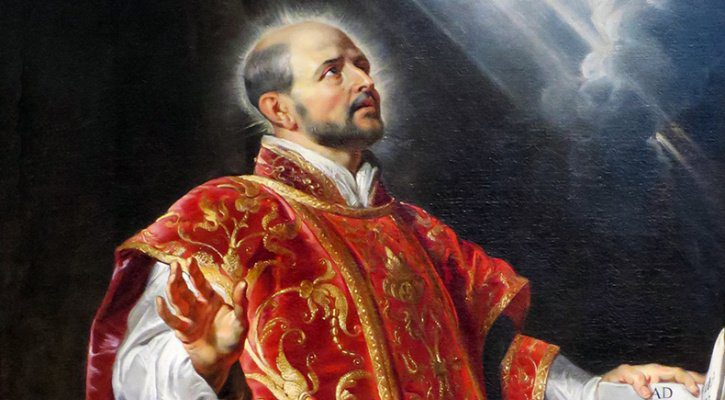
Ignatius’s legacy of disciplined inquiry, moral courage, and public service shapes Georgetown’s commitment to its military-connected students. From our early years and involvement in major wars to our present-day ROTC programs and veteran support initiatives, the university honors this Jesuit tradition by fostering leadership and academic excellence among those who serve.
The Georgetown College Cadets
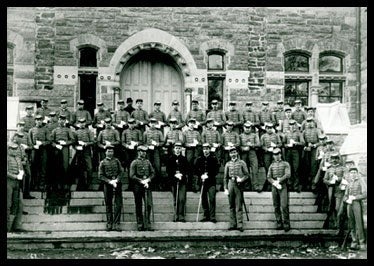
In 1836, Georgetown students established the Georgetown College Cadets, a military organization that foreshadowed today’s Reserve Officer Training Corps (ROTC). Entirely student-led, however, the Cadets offered no formal pathway to a military commission; graduates who wished to become officers were required to pursue that goal independently.2
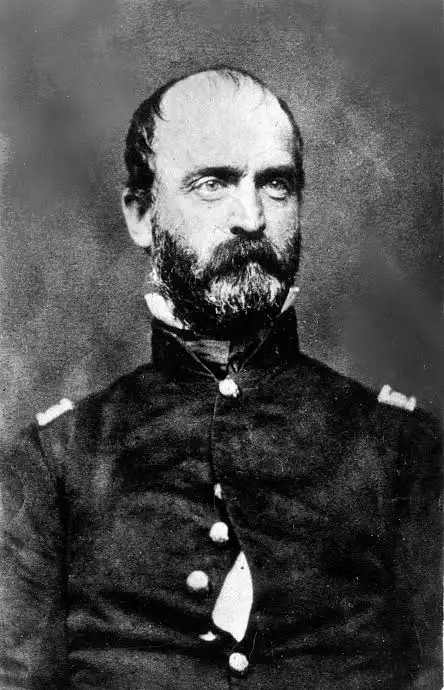
Two of the original members of this group were likely Henry Heth and Lewis Armistead. Heth graduated as valedictorian in 1837 and commissioned into the Army soon after, later serving as a major general for the Confederacy during the Civil War where he commanded a division of A.P. Hill’s Corps at Gettysburg Armistead attended preparatory classes at Georgetown before attending West Point, where he was infamously expelled after he broke a plate over Jubal Early’s head in the mess hall. Like Heth, Armistead became an Army officer after graduating and was later a brigadier general for the Confederate States Army. On July 3, 1863, as part of Pickett’s Charge during the Battle of Gettysburg, Armistead led his brigade to the farthest point reached by Confederate forces during the charge, now referred to as the “high-water mark” of the Confederacy. Ultimately, Confederate troops were overwhelmed and forced to retreat; Armistead was wounded and captured by Union forces, and died in a field hospital two days later.
Although Georgetown retained some level of administrative control, the College Cadets largely governed themselves. They imposed fines on fellow cadets for a range of offenses, including speaking out of turn during meetings, disobeying superior officers, and mishandling weapons. Obtaining arms proved to be one of the Cadets’ earliest challenges. The federal government was initially reluctant to issue military weapons to civilian college students.3 To acquire rifles, the Cadets had to register as a volunteer militia and on June 13, 1838, the government supplied the College Cadets with Sixty short flintlock muskets.4
According to the University Archives, the original Cadet organization dissolved by the early 1840s before reorganizing in 1852 under a more formal constitution and stricter code of conduct. While the status of the Cadets’ Militia and the whereabouts of the rifles during the 15-year period of inactivity remain unknown, it does appear that the Cadets and the Government entered into other munitions agreements in the late 19th-century. More correspondence between Georgetown President J. Havens Richards, S.J., and the War Department’s Ordnance Office regarding rifles on loan to Georgetown can be found in the University Archives.5
Behind the Blue and the Gray: Georgetown in the Civil War
During the Civil War, Georgetown University found itself both physically and ideologically entangled in the domestic conflict. Situated on the Potomac River, Georgetown was uniquely located along the boundary between the Union capital, Washington D.C., and Confederate Virginia.
The university remained open throughout the war, a rare feat among Southern and border-state schools, though the student body shrank from 313 to 17 between 1859 and 1861. A total of 1,141 students and alumni served in the war; approximately 900 fought for the Confederacy and 200 for the Union.6
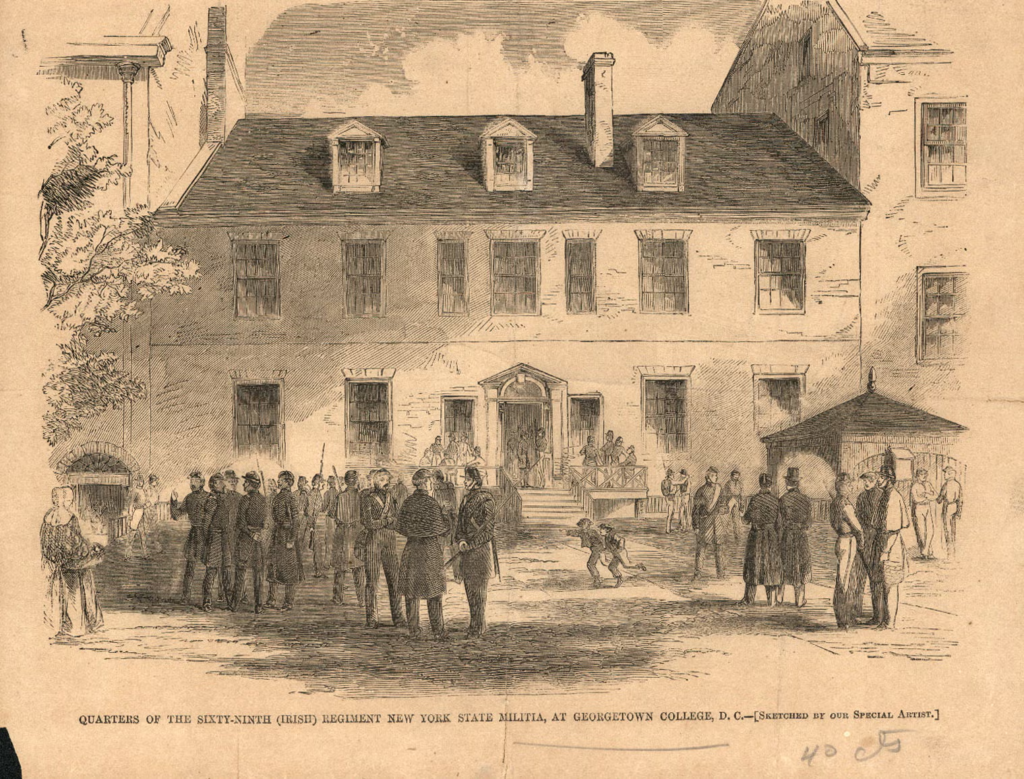
In 1861, Georgetown housed the Union Army’s 69th Infantry Regiment of New York for three weeks, during which President Lincoln and several members of his cabinet visited to review them. It is rumored that this regiment’s arrival was punishment for a student protest against President Lincoln, in which a caricature of him was publicly burned. Fr. James Clark, S.J, who was on faculty at the time, wrote that this protest “created quite a stir among the government officials who loudly condemned such a proceeding. … Very soon after, the New York regiment was quartered at the College.”7
In 1862, after the Second Battle of Bull Run in Manassas, Virginia, several campus buildings were repurposed as military hospitals. The influx of soldiers to campus not only disrupted building space, but faculty members also took on new roles in support of the war effort. Staff at the medical department provided aid to the wounded in hospitals and on the battlefield; in fact, the school’s medical department was the only Georgetown department whose enrollment rose during the war.8
In 1876, when the Georgetown College Boat Club, now the crew team, was founded and needed team colors, Georgetown students settled on Blue and Gray: “desiring colors to both honor Georgetown students and alumni who had fought in the Civil War and to express ‘the feeling of unity that exists between the Northern and Southern boys of the College.’”9
Students returned to the hilltop after the war – learning, working, and living alongside those they had just fought. The College Cadets resumed their regular schedule of parades and drill competitions, however, overall passion about military service shrank considerably in wake of the war. As one student remembered, “drill was not very popular, for there was no great military spirit among the boys.” Furthermore, when Ulysses S. Grant, the commander who had defeated Robert E. Lee became president in 1869, the predominantly Southern cadet corps was reluctant to pledge their allegiance to the new administration. The Georgetown College Cadets did not return to their earlier levels of coordination until the late 1880s.10
Preparing Officers for a New Century: World War I
More than 2,000 Georgetown men, students and alumni, served in World War I. During the war, University President W. Coleman Nevils, S.J. petitioned the War Department to establish a Reserve Officer Training Corps (ROTC) program on the hilltop and in 1918, Army ROTC officially began at Georgetown. Initially established as an Infantry Unit Senior Division, this original program restricted graduating cadets to commissioning exclusively into the Infantry branch.11
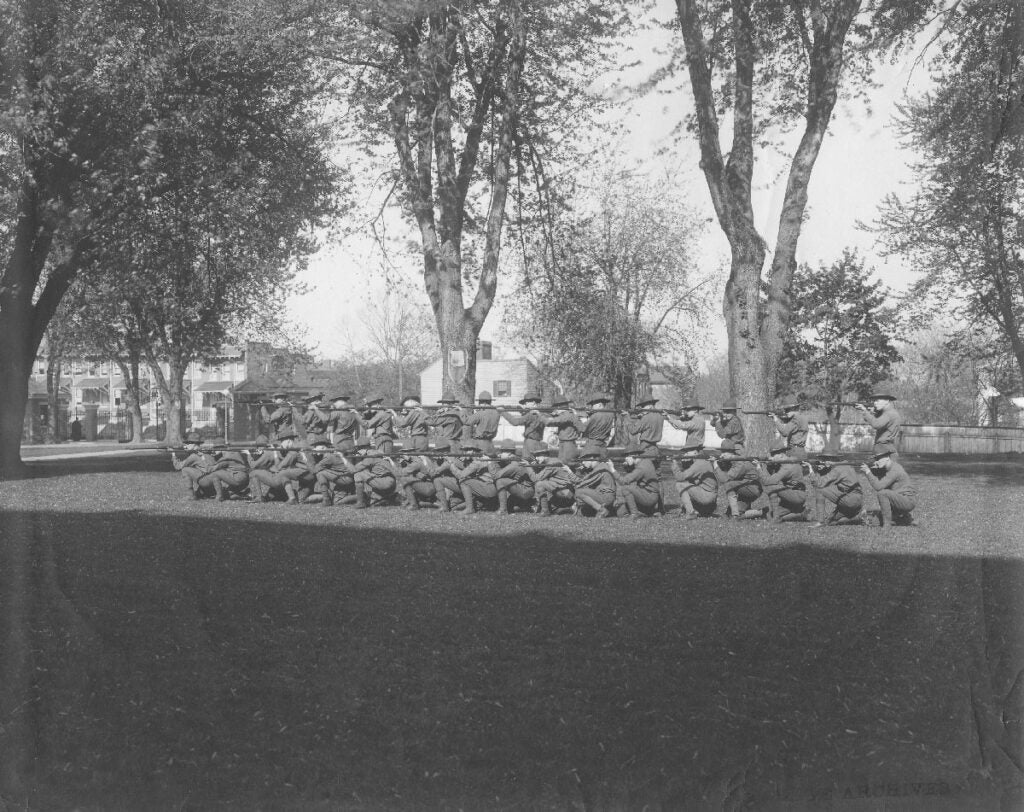
Not only did the ROTC program bring military training to Georgetown’s campus, but it helped lead to the creation of the School of Foreign Service (SFS). During the war, the War Department enlisted the dean of Georgetown College, Father Edmund A. Walsh, S.J to help design the academic framework for the Student Army Training Corps (SATC). While ROTC keeps students as civilians, the SATC was a temporary, wartime mobilization program where students served on active duty but were still able to pursue their higher education. The Hilltop functioned as both a military training camp and an academic institution.
It is from this experience that Fr. Walsh recognized a lack of national diplomacy education and decided to create a school dedicated to international affairs. He saw Georgetown – with its Washington, D.C. location and service-driven mission – as uniquely suited to become home to the country’s first school centered on diplomacy.12
Mobilizing a Campus: World War II and the Postwar Era
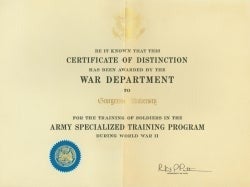
During World War II, Georgetown once again assumed a central role in the nation’s defense effort. Selected by the War Department to host the Army Specialized Training Program (ASTP) and one of only thirty-one institutions chosen for the Specialized Training and Reassignment (STAR) program, the University became a key center for preparing military personnel for specialized wartime service. This designation transformed the university into a center for preparing military personnel in fields critical to wartime needs, such as language, engineering, and medicine. By the 1943-44 academic year, more than 75% of Georgetown’s students were active military servicemen, and the campus adapted accordingly to meet the demands of training future officers. In order to increase declining enrollment numbers due to the war, women were permitted to enroll in the SFS in 1944.13
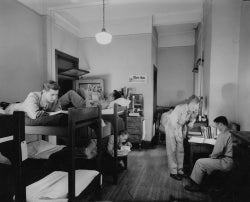
George A. Wolf, a 1939 graduate, was killed aboard U.S.S. Arizona during the attack on Pearl Harbor and was the first Georgetown graduate to die in World War II.14 170 other alumni perished, including John Paul Beall. Beall was an honor graduate of the Infantry ROTC in 1941 who participated in the U.S. coastal invasion of Algeria; he was killed in action in Tunisia in 1943. Al Blozis, who played football for Georgetown from 1939 to 1941, was killed in France in 1945.15
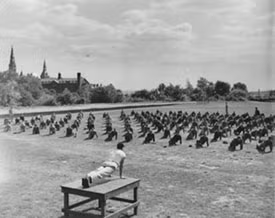
In the postwar years, the Servicemen’s Readjustment Act of 1944 (GI Bill) opened the doors of higher education to thousands of returning veterans. In 1945, the Veterans Administration established an office in Old North to assist with veteran enrollment under the GI Bill. By spring of 1946, veterans made up more than 80% of students in the School of Foreign Service.16
Service and Protest: Korea, Vietnam, and a Changing Campus
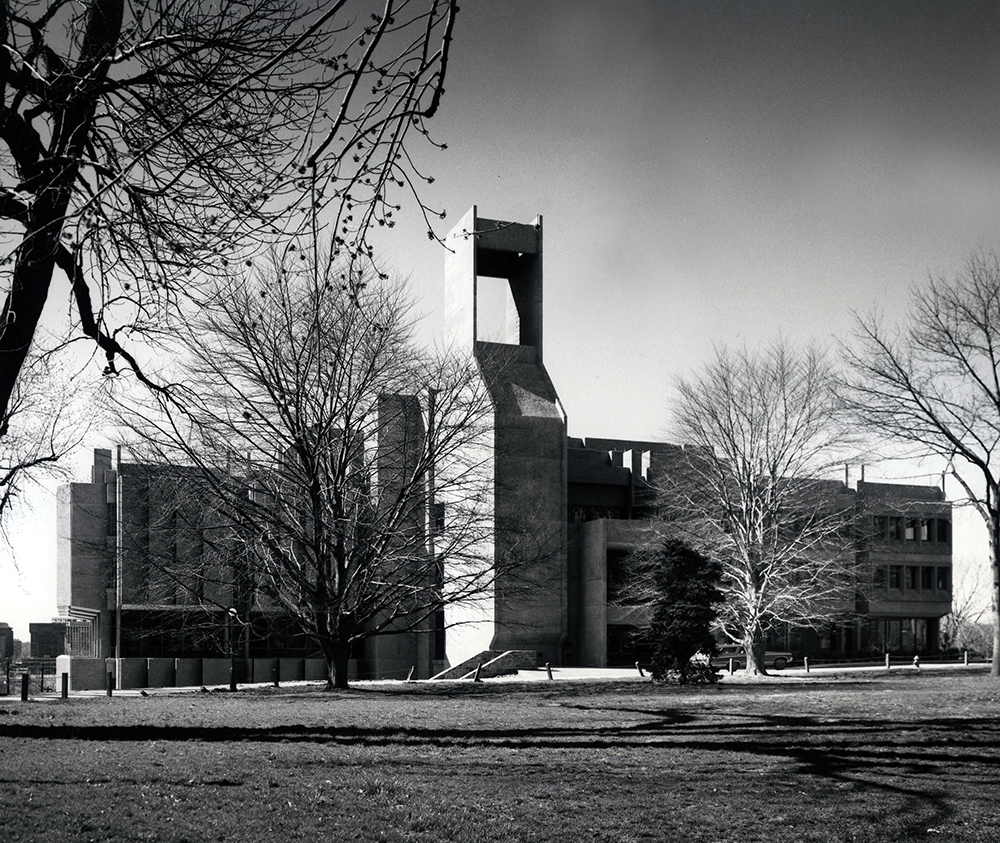
During the Korean and Vietnam Wars, many Georgetown alumni once again answered the call to military service. Harry W. Spraker, Jr. (C’50) earned both the Bronze Star and Silver Star before being killed in action on February 4, 1951; today, Georgetown Army ROTC’s rifle drill team, the Spraker Rifles, bears his name in tribute.17 After First Lieutenant Joseph Mark Lauinger (C’67) was killed in action on January 8, 1970, the University announced that its new library building would be named in his honor. At the dedication, University President R.J. Henle, S.J., reflected that the “new library will stand, through Joseph, as a monument to the Georgetown men and women who have sacrificed and given of themselves, in peace as well as in war… The Joseph Mark Lauinger Memorial Library is a sign to all that a grateful Georgetown has not forgotten.”18
Like many American college campuses during the Vietnam War, Georgetown became a center of anti-war activism throughout the late 1960s and early 1970s. In 1969, approximately fifty students staged a sit-in at the ROTC office, and in 1970, amid continued protests from students and faculty, ROTC classes were canceled and cadets were denied academic credit.19
The controversy persisted after the end of the war. In 1973, the School of Foreign Service proposed making ROTC an academic department and awarding limited academic credit for ROTC coursework. However, the proposal was abandoned after several faculty members and one student conducted a weeklong hunger strike in protest.20 Today, Army ROTC courses are fully integrated into Georgetown’s curriculum: the required freshman, sophomore, and junior courses each carry one academic credit per semester, while the senior-level course is worth three credits.
The Post 9/11 Era
The wars in Afghanistan and Iraq ushered in a new chapter in Georgetown’s relationship with the military. As servicemembers returned home and pursued higher education under the Post-9/11 GI Bill, Georgetown expanded its commitment to military-connected students beyond officer training. The University became a Yellow Ribbon Program participant, which finances part or all of the tuition and fees not covered by the Post-9/11 GI Bill, enabling veterans and their families to finance a Georgetown education while reinforcing its longstanding mission of service.21 In 2008, students and faculty established the Georgetown University Student Veterans Association to advocate for veterans on campus and foster a sense of community.22 Three years later, the Georgetown University Veterans Office (now MAVRC) introduced the full-time position of veterans office coordinator to assist military-connected students in navigating the transition from military service to academic life.23
These efforts have reshaped Georgetown’s military community. Between 2013 and 2021, enrollment of military-connected students more than doubled, increasing by 110 percent while enrollment of non-military connected students grew by just 7 percent.24 In 2026, military-connected students totaled 1,500 students, comprising approximately 11% of Georgetown’s graduate student population and 3% of its undergraduate population. Through the MAVRC, Georgetown provides academic advising, career support, and other services that have contributed to an 85% degree-completion rate among Georgetown’s military-connected students – well above the national average for student veterans.25
ROTC at Georgetown Today
Georgetown University now participates in the Army, Naval, and Air Force ROTC programs. The 1964 ROTC Visualization Act formally authorized the Army and Air Force to offer merit-based scholarships for students in or entering college (whereas the Navy began offering scholarships in 1947).26 In the same year, the Consortium of Universities of the Washington Metropolitan Area was established: the presidents of Georgetown University, American University (AU), The Catholic University of America (CUA), George Washington University (GWU), and Howard University signed a charter that allowed students at any of the five schools to cross-register for courses, share resources, and collaborate on academic and research initiatives.27 Since the consortium’s inception, Georgetown has served as a host school for the Army ROTC Hoya Battalion and is home to cadets from AU, CUA, GWU, IWP, and now Howard. AROTC offers the opportunity for students to commission as an officer in the Regular Army (Active Duty), the National Guard, or the Army Reserve.28 AROTC offers two-, three-, and four-year scholarships and only requires two years on campus. In addition to on campus training, AROTC cadets will have the opportunity to shadow active duty lieutenants and attend military schools during the summer.
In 1983, GWU established a Naval ROTC unit and it is now home to the Capital Battalion, hosting the Georgetown, Howard, and CUA NROTC programs.29 Navy ROTC offers the opportunity for students to commission as an Ensign in the US Navy or a Second Lieutenant in the Marine Corps. To complete NROTC a student is required to complete four years in the program on campus, meaning that students must either win the national scholarship while applying as a high school senior or receive a scholarship as a “walk-on” during their freshman year. Students are not permitted to join the program after their sophomore year and are not permitted to remain in NROTC beyond their sophomore year unless they win a scholarship.
Similar to NROTC, Georgetown does not host its own Air Force ROTC unit. Instead, Georgetown students participate in Detachment 130 at Howard University, which was established in 1946. The cadet corps is comprised of cadets who attend the consortium schools including Georgetown, AU, CUA, GWU, Marymount University, Trinity University and the University of the District of Columbia.30 AFROTC requires students to participate on campus for three years and is open to both undergraduate and graduate students.
Nearly two centuries after the Georgetown College Cadets first assembled on the Hilltop, Georgetown continues to prepare men and women for lives of service through military leadership. From the Civil War to the present day, the University’s military history reflects an enduring Jesuit commitment to educating leaders dedicated to serving both their nation and the common good.